
The metabolism of inquiry pulses with an accelerant vigour, and scientific boundaries are becoming wonderfully porous. Biology now speaks to mathematics, computer science to cognition, and we see explorers venture across domains to grasp at truth. Michael Levin is among the boldest of these voyagers. At Tufts University his laboratory studies developmental bioelectricity, morphogenesis, regeneration and cognition in cellular collectives. Its work on Xenobots and Anthrobots makes especially vivid how cells can acquire capacities which their familiar arrangements never display. Levin has carried these discoveries into an experimentally motivated Platonism, intent on overcoming physical reductionism without confining himself to immutable Forms. But there is another way past reductionism, one that does not extract the intelligibility of living systems from their activity, unload it in a separate realm, and then summon it back to explain the life it has left behind.
In A Short Argument on Platonic Space (31 March 2026), Levin asserts that “There are facts which are not physical facts.” He points to prime numbers, topology, and mathematical relations that changing the universe's physical constants would leave intact. So far, so good. But mathematics is only the beginning of his ambition. The deeper provocation comes from his experiments themselves: how can a handful of cells, rearranged into an unfamiliar collective, exhibit capacities that neither the experimenter designed nor the evolutionary history of that particular collective selected for? Levin suspects that the physical arrangement is a modest interface to a far richer space of possible forms, whose mathematical structure precedes any particular embodiment. The necessity and purported non-physicality of mathematics give this space its apparent independence, while the astonishing resourcefulness of living systems gives it explanatory urgency. Yet neither in fact establishes that the forms must inhabit a separate realm, much less enter the world as causes from beyond it.
Levin's challenge to reductionism deserves an answer that does not return biology to an inventory of mute physical parts. His interactionism is explicit, provisional and experimentally ambitious; he even allows that the two spaces might prove to be aspects of a deeper reality. For a pragmatist, if Platonic Space is a useful way to investigate forms, its value is measured by what it reveals. And if patterns supply causal input from elsewhere, we must understand how the purported source, the embodiment and their relation are determined. We shall see that Levin's own experiments provide the grounds for questioning the separation proposed by Platonic Space. They reveal living wholes whose parts make and remake the relations through which the whole takes shape and acts. With the sciences now sailing so freely across their old borders, someone might do well to deliver biology the long-overdue obituary of the separation of thought and being from the black forest of philosophy. Let us see whether it survives the crossing.
Treating the flock’s center as its pilot mistakes a description of its motion for a cause.
The abstract universal: what does the common name ‘pattern’ explain?
In A Short Argument, and more extensively in Ingressing Minds, Levin brings mathematical invariants, dynamical systems, organisms and minds under the capacious designation of pattern. His continuum of agency invites us to investigate what these very different things can do, from preserving an invariant to learning and revising a goal. But a prime number, a whirlpool, a salamander and a thinking subject do not become intelligible merely by receiving the same surname. Their common designation is an abstract universal: it gathers them together precisely by leaving their decisive differences outside the account. A concrete universal would have to be discovered in the development of those differences themselves. The aforementioned family resemblance leaves us with many questions: Why does the whirlpool maintain a recognizable form without maintaining itself as a living organism does? Why can the salamander regenerate a limb without asking whether it ought to grow one? And what happens when a being can make its own purposes an object of thought? Registering and arranging these distinctions does not explain their necessity. [1, 2]
A mathematical constant has no enemies. It does not struggle to be itself, to preserve itself against a hostile environment. The salamander has a more demanding existence. It must continually reproduce its own life, drawing its surroundings into a metabolism whose organs acquire their functions through the activity of the organism as a whole, an activity sustained in turn through those organs. In a thinking subject, even the purposes governing activity can themselves become objects of examination and transformation. We have encountered differences in the very manner of being, and the universal can be grasped concretely only as we comprehend their necessity and the transformations through which these forms of activity arise. Classification alone does no work to show necessity.
Levin's more radical claim takes us beyond classification. In §6.4 of Ingressing Minds, a pattern may appear as the agent, with the embodied machine serving as its scratchpad. The division between machine and data can itself shift with the observer. We can inspect the same organized process under different descriptions, foregrounding now the computational pattern, now its physical implementation. The freedom to reverse our descriptions, however, grants no corresponding freedom to reverse the conditions of existence. The mathematical pattern remains available for study apart from this particular machine; that is its richness and poverty. The actual agent must still acquire its powers through a determinate organization, and the question of how that organization constitutes its activity has not disappeared merely because we have moved the scratchpad to the other side of the desk. [2, §6.4]
Mathematical necessity needs no second address
Levin opens his case for Platonic Spaces by observing mathematical truths do not depend on the particular physical constants of our universe. It would be absurd to suppose that changing the mass of an electron could change the value of e. But what, precisely, follows from this?
Levin declares: “If you agree that you can’t simply dissolve the math department, then that’s it – we have 2 distinct (but interacting) realms.” In a later reply he makes the choice stark: “Unless you have a rebuttal of how to reduce mathematical objects to facts of physics, we must adopt a Platonic-like view.” [4] The dichotomy remains false. The necessity of mathematics cannot be manufactured by altering physical constants; neither must its objects therefore become separately acting causes. The determinate relation between mathematical form and physical actuality is precisely what the choice between reduction and a second realm leaves unexamined.
Levin can reply that the word 'realm' is optional. He expressly sets aside the question whether Platonic Space is ontologically real and, in a footnote to Ingressing Minds, declines to distinguish fully its status as metaphysical entity from epistemic framework. Even his suggestion that mathematics might be folded into an enlarged physics preserves two distinguishable domains of inquiry. Fair enough. What cannot remain merely verbal is the claim of information or causal input from an independently constituted space. If no extra input is meant, the second address contributes no ontological explanation; if it is meant, the distinction must make a discoverable difference. [1; 2, §1(e), n. 1]
Mathematical form can be understood without pointing to one particular empirical instance. That independence of a particular instance does not make the form a self-sufficient being, nor reduce its necessity to the physical circumstances in which we encounter it. An unbuilt bridge can be mathematically described; the possible structure has objective determinations. But those determinations do not assemble steel, and the steel does not manufacture mathematical necessity. In an actual bridge, the mathematical relations become determinations of a structure whose materials, loads and construction conditions give them a particular existence. We must understand this determinate unity of form and actuality without assigning either a separate residence and subsequently inventing a passage between them. Levin's two addresses turn a distinction within intelligibility into a transaction between supposed occupants.

When mathematics becomes causal
Once mathematics has been assigned a distinct domain, Levin asks that it do explanatory work: “if they were different, facts in the physical world would be different.” It is an argument from mathematical constraint and counterfactual dependence to a distinct kind of causation. Its force deserves examination, since the leap from formal necessity to independent cause supports the rest of the architecture. [1]
In his example, a different distribution of primes would have altered the familiar 13- and 17-year cycles of periodical cicadas. This is a serious point about explanatory relevance. The mathematics helps specify which periodicities could reduce encounters with predators or competing cycles. Levin also argues that mathematical relations can enable biological capacities, rather than merely constrain them. We should grant both claims without smuggling in the conclusion about an independent causal realm.
The counterfactual concerning primes is not an ordinary intervention of the sort contemplated in Pearl's causal modelling. Levin himself acknowledges that nothing physical can change their distribution, while his engineer's notion of cause appeals to what one can “intervene on, understand, and exploit”. His additional criterion treats the most illuminating reason for research as causal. Such explanatory relevance is genuine, but depends partly on the question the investigator asks. It does not establish an additional causal agent. Levin recognizes that the term 'cause' may need revision and defers a fuller account to another paper. The inferential burden remains: what turns the mathematical determination of possible periodicities into an input from a separately constituted domain? [1; 2, §1, second lettered list (c); 4]
Consider what the counterfactual asks us to imagine. If the distribution of primes were different, what else would have to change? Divisibility, periodicity and the distribution of primes acquire their determinations through a common mathematical structure. To alter one is to confront the relations through which it is what it is. We may construct alternative mathematical systems and investigate their consequences, but this does not furnish a dial by which one independently varies the primes while keeping their determining relations intact. The counterfactual is illuminating precisely because mathematics has its kind of necessity: certain possibilities follow from determinate relations, and others are excluded. In the cicada, those possibilities acquire biological significance through development, reproductive timing, ecological pressures and the organization of the life cycle. Arithmetic helps determine what is possible for such a creature. None of its necessity has been lost by belonging to the intelligibility of that process.
Levin's Pythagorean reply asks why mathematical constraint should not count as interaction between the physical and non-physical. But consider what would make the proposed interaction more than a new name for the relation we have already discovered. The mathematical determination has been isolated from the concrete process, imagined as an independently constituted term, and then credited with producing the very dependence through which we first identified it. The direction of explanation has quietly been reversed. This becomes clearer when we examine causation itself. Cause and effect acquire their determinations through the process in which they operate: the cause is actual in its effect, the effect transforms the conditions of subsequent activity, and those conditions enter into further determinations. Follow the relations of the cicada's life far enough and arithmetic appears throughout them, specifying genuine possibilities and impossibilities. Levin abstracts these mathematical determinations from the concrete relations in which they acquire biological significance, treats their independence in thought as an independence in existence, and finally invokes them as causes of the very process from which they were abstracted. The necessity of mathematics has thereby been converted into the supposed necessity of an external cause. It is this conversion that requires justification, and the counterfactual has supplied none.
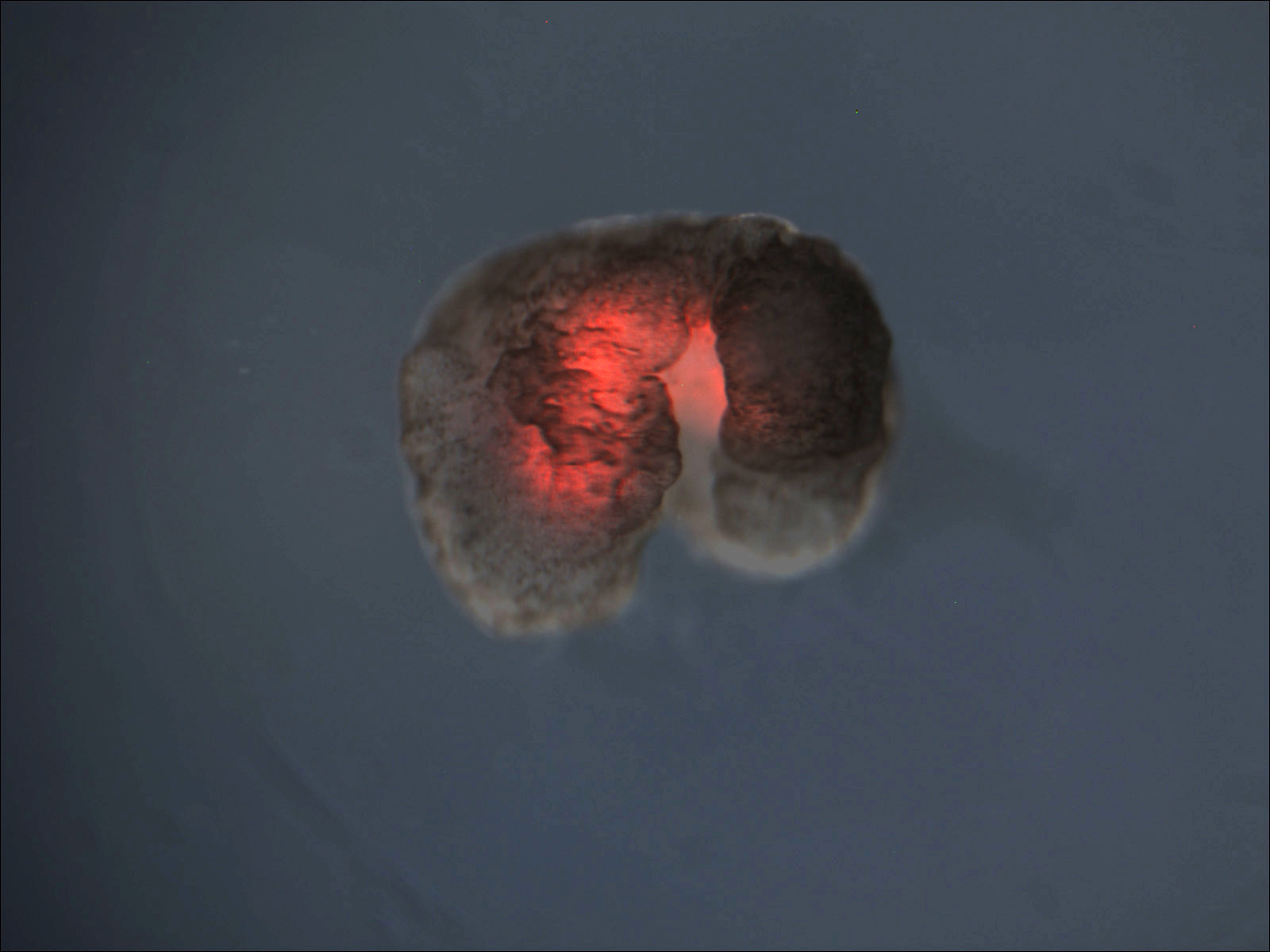
Where did the Xenobots come from?
Xenobots built from frog cells and Anthrobots assembled from human cells have exhibited capacities absent from their familiar anatomical arrangements. Anthrobots have aided neural wound closure in experimental settings. Xenobots, for their part, have shown unexpected collective behaviours. Their precise engineered configurations lack an evolutionary history of selection. Levin properly refuses to let 'emergence' serve as a congratulatory name for our surprise. He notes that no one predicted the new transcriptomic and behavioural features in advance. A genealogy supplied after the fact is not yet a predictive explanation. [1, 2]
Cellular history still matters. The constituent cells inherit bioelectric, biochemical and developmental competencies, whose new interrelations alter what the collective can do. Yet this answer must not become the very retrospective story Levin criticizes. The task is therefore prospective, to predict how changes in coupling, geometry, tissue history and boundary conditions alter the repertoire of attainable forms. If those predictions fail, go on and investigate why. Do not merely invoke 'emergence' with greater solemnity.
Levin explicitly rejects the inference that Anthrobots alone establish Platonic ontology. He also insists upon a second experimental pillar: minimal computational systems whose components are fully specified. Their sorting, de-sorting and clustering behaviours deprive us of any easy appeal to the evolutionary history of cells. The stronger demand is for a prospective account of these competencies, rather than a retrospective label. [2, §§5.5, 6.3, 7.3]
Mapping developmental possibility spaces could transform synthetic biology and the design of minimal agents. Failure is glorious, and even a metaphysics that fails might encourage excellent experiments. But the claim that a space of possibilities supplies causal power from beyond embodiment incurs a different obligation. Predicting what a system can do by exploring its affordances leaps too far if it thinks it has established which ontology made that prediction true.
The risk is that genesis quietly becomes retrieval. In §5.3 of his longer paper Levin explicitly treats the complexity of form as pointed to by a seed and retrieved across a pattern space and its physical interface, rather than constructed through an embodied developmental process. As a research metaphor, I can see how retrieval encourages the search for recurrent possibilities. As an account of origin, it still has to explain why this configuration, with these histories and constraints, realizes this capacity and another does not. Its work remains to be done exactly where a theory of immanent organization begins. [2, §5.3]
The thin client and its ineffable server
Levin's technological analogy carries the shift from genesis to retrieval a little further. In the short essay, the organism resembles a thin client; in the longer paper, a pointer: a small piece of information that specifies where to find something much larger in a computer's memory. The metaphor captures the disproportion between a modest experimental arrangement and its astonishing capacities. But a pointer works only within an already constituted system of memory, addresses and rules of access. What constitutes the corresponding relation between embryo and Platonic Space? Without an answer, the mystery of development has merely acquired a server. Levin himself concedes that the pointer metaphor must eventually fail. [1; 2, §5.3]
His minimal computational systems sharpen the difficulty. Sorting algorithms can temporarily decrease sortedness when swaps are blocked, and distributed algorithms can cluster by type. Levin knows perfectly well that their rules are inspectable and their execution may be deterministic, and his challenge is to explain why these rules yield such unexpected competencies. The task is to derive the behaviour, predict its alteration under changed rules and conditions, and discover whether anything escapes that account. Surprise does not establish additional computational input, any more than mathematical intelligibility establishes an independently acting mathematical cause. [2, §§5.5, 6.3]
Levin even allows that patterns and embodiments may modify one another. This is a critical move, for if each acquires its determinations through its relation to the other, what becomes of their supposed independence? Reciprocal action makes the separation harder to sustain, not easier to explain. It is tempting to furnish two worlds and then congratulate ourselves on connecting them, but we must discover the relations through which these forms and capacities arise. [1; 2, §1, §7.3]
The problem of mutable patterns
“Are the patterns unchanging and eternal? I don’t commit to that.” — Michael Levin, A Short Argument on Platonic Space
Levin's strongest reply distinguishes the kind from its occurrence. The closing discussion of Ingressing Minds suggests that a kind of mind may be available beforehand, while an individual instance emerges and is moulded by embodied experience. But a universal kind does not act as an individual, nor is the individual a merely accidental container for an already complete universal. The living particular gives the universal determinate actuality, and in turn its activity is intelligible through the kind of whole it constitutes. What must be explained is this becoming-individual, not a pre-existing mind selecting a temporary scratchpad. [2, Fig. 10C, §7.3]
The static and the mutable must be kept apart. The value of e raises the question whether mathematical necessity entails an independently existing cause. A developing mind raises another: what individuates a pattern through changes that partly constitute it? We gain nothing by forcing both cases into a single refutation.
One might insist that the general kind remains independently real and the individual merely instantiates it. But instantiation is precisely the relation requiring explanation. An abstract type cannot determine which individual exists, what it does or how it changes merely by remaining abstract. The organism's self-maintenance, differentiation of parts and environment, and capacity to transform its own conditions are determinations of the agent itself. Where Levin gives the pattern priority over its embodied 'scratchpad', he mistakes a moment abstracted from the living whole for that whole's source.
Can the research programme save the metaphysics?
Pragmatically-minded, Levin is willing to surrender the independence of his two realms, provided the distinction continues to earn its keep in the laboratory. He allows non-reductive monism, entertains the possibility that his two spaces are aspects of a deeper reality, and asks what practical difference the metaphysical quarrel makes. Framings matter, and provisional dualism lays us a trap when it directs us to seek extra causal input and interpret novel competencies as retrieval. A framework becomes scientifically consequential through what it leads us to measure, predict and explain. [2, §1, n. 7; 4]
Levin does make a distinctive experimental wager: computation beyond conventional accounting, perhaps even requiring revisions to thermodynamic bookkeeping. This deserves testing against predictions derived from the system's organization. A reproducible contribution that the latter cannot account for would favour Levin, though it would not by itself establish ingress. His sorting-and-clustering example is instructive: the clustering may be an astonishing second service, but its surprise does not establish a second supplier. Nor should we confuse the discovery of useful capacities with evidence for a particular causal ontology.
Levin refreshingly challenges his critics to produce a scientific roadmap of their own. We can accept the challenge without surrendering any of his experimental ambition. Vary the couplings, rules and boundaries of a system, predict how its space of reachable competencies changes, and discover forms of agency that neither evolution nor the experimenter anticipated. Much of Levin's own work already proceeds in this spirit. His experiments are leading us toward a better metaphysics than Platonic Space allows: one in which mathematical possibility is objective, living forms develop through their own determinate relations, and the emergence of unfamiliar minds belongs to the powers of nature itself. There is something more beautiful in this immanence: we can keep the entire research programme, with all its surprises and strange new creatures, without dispatching their capacities to another realm. If Platonic Space contributes something further, let it show us where. [2, §1, n. 7, §§4.2, 5.5, 7.3]
| Criterion | Platonic Space, even as heuristic | Immanent alternative |
|---|---|---|
| Source of novelty | Frames unexpected capacity as access or retrieval | Predicts its genesis from organization and changing constraints |
| What differs | Also varies coupling, rules and boundaries | Predicts how these interventions alter reachable possibilities and their costs |
| Accounting | Predicts extra computation beyond conventional accounting | Tests that prediction against the full implemented dynamics and resource tally |
| Explanatory cost | Additional causal input needs independent measurement | Explains the same affordances without positing an extra input unless required |
The restless intelligibility of actuality
An immanent science of form investigates how a whole determines its parts and conditions while existing only through their activity. A living collective produces and maintains its own boundary through regulation. Go and alter its bioelectric connectivity or tissue organization, and see what it can sustain as a goal. Even minimal algorithms exhibit a determinate field of possible transitions, though their execution should not be confused with living self-relation. Such possibilities are objective, experimentally discoverable, and require no ghostly cause standing behind the process.
As we drain Levin's Platonic Spaces back into the world, consider the whirlpool that forms along the way. Its spiral can be described mathematically whether or not this particular vortex exists. Yet here, in front of us, it exists through the movement of liquid, pressure and boundary. Its form is the intelligible determination of that movement. Alter the relations and the vortex changes or disappears. Levin may call the drain a pointer to a space of vortices, but the pointer tells us nothing of why this one exists.
In the lab, a salamander jolts. Observe it regrow a severed limb. The whirlpool maintains its form through moving matter, but it cannot repair itself according to the requirements of its own life. The salamander reorganizes cells, tissues and signals to restore a limb whose parts acquire their functions through the developing whole. We marvel at discoveries in bioelectric field manipulation, but no intact limb is here fetched from a celestial catalogue. The question is how the organism determines what counts as damage and restoration, and reconstitutes the conditions of its own existence. Here lies the deeper promise of Levin's biology. Beyond life, reflective agency introduces another transformation: a subject can examine and revise its own ends. Neither regeneration nor freedom is explained by climbing a ladder of pattern complexity.
Levin rightly refuses to let emergence become a ceremonial name for ignorance. His own ontology deserves the same scrutiny. Mathematical necessity and unforeseen competence establish no independent causal residence for form. If Platonic Space names objective possibilities, we can investigate them through the development of concrete systems. If it supplies an additional cause, let that contribution be demonstrated. Levin abstracts intelligible form from actuality, grants the abstraction an independent address, and summons it back to explain the actuality from which it was taken. His experiments reveal something richer than this metaphysical round trip: a world whose forms become intelligible through the very activity by which they become what they are.
References
- Michael Levin, “A short argument on Platonic Space: variable-agency patterns that in-form physics, biology, computer science, and cognitive science,” Forms of Life, Forms of Mind, 31 March 2026. https://thoughtforms.life/a-short-argument-on-platonic-space-variable-agency-patterns-that-in-form-physics-biology-computer-science-and-cognitive-science/
- Michael Levin, “Ingressing Minds: Causal, Non-Physical Patterns In-Form Natural, Synthetic, and Hybrid Embodiments,” Philosophies 11, no. 5 (2026): 161. https://doi.org/10.3390/philosophies11050161
- Matthew David Segall, “Patterns Are Not Puppeteers: The Return and Reformation of Platonic Form in Biology,” Footnotes2Plato, 10 November 2025. https://footnotes2plato.substack.com/p/patterns-are-not-puppeteers-the-return
- Michael Levin, original replies in “Symposium on the Platonic Space,” Forms of Life, Forms of Mind: 29 August 2025 (reply to Alexey Tolchinsky on the engineer's notion of causation and possible new terminology); 9 and 11 November 2025 (exchanges on mathematical objects, pragmatic hypotheses, dualism, and possible deeper unity); 3 January 2026 (reply to Tolchinsky on sorting/clustering and computational accounting). https://thoughtforms.life/symposium-on-the-platonic-space/