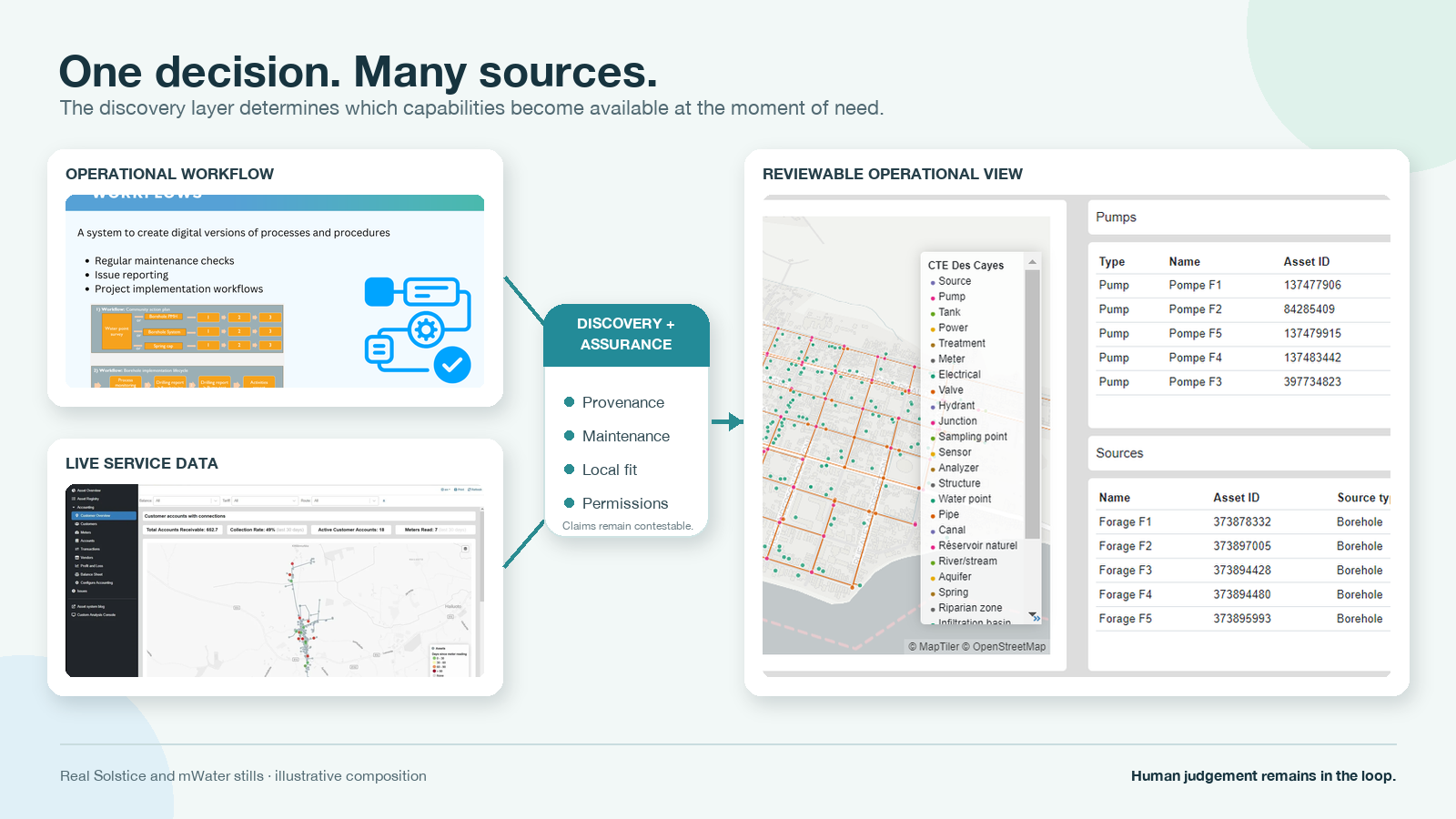
This note sets out the arithmetic behind an indicative estimate of the value of a public-interest discovery and assurance service for AI agents. Such a service would help agents find and evaluate operational tools, data sources, APIs, workflows and specialised agents using transparent evidence about provenance, maintenance, security, licensing, operating context and real deployments.
The estimate is not a valuation of a company and it is not a revenue forecast. It is an estimate of public value: professional time released, duplicated or failed investment avoided, and better outcomes from public and development spending.
A plausible high-success scenario once the service is used internationally by major public institutions and agent platforms. A central scenario is approximately $280 million a year.
Important: the $1 billion figure is a scenario, not a prediction. It depends primarily on adoption. A technically sound catalogue that is rarely consulted would produce only a fraction of this value.
The model in one table
| Annual value channel | Conservative | Central | High success |
|---|---|---|---|
| Professional time released | $5.3m | $75m | $360m |
| Avoided duplication and unsuitable choices | $1.9m | $30m | $187.5m |
| Better programme and operational outcomes | $34.9m | $174.3m | $522.9m |
| Total annual public value | $42m | $279m | $1.07bn |
These channels should be measured carefully in any real evaluation because some benefits can overlap. The model keeps the assumptions deliberately simple so that they can be challenged and replaced.
1. Professional time released
Programme teams, government staff, technical advisers and procurement specialists spend time finding tools, establishing whether they are maintained, comparing weakly documented options, checking provenance and locating evidence from previous deployments. Agents will perform more of this work, but an agent without a trusted discovery layer merely conducts the same uncertain search faster.
The central case assumes 50,000 users, 30 hours saved and a loaded cost of $50 per hour, producing $75 million in annual value. These are productivity gains, not necessarily budget reductions: the more realistic benefit is that scarce professional capacity can be redirected towards implementation, local adaptation and human judgement.
2. Avoided duplication and unsuitable choices
Public-interest software is frequently rebuilt because previous work cannot be found, assessed or trusted. Other losses arise when organisations select systems that are abandoned, insecure, incompatible with existing infrastructure, unsuitable for local connectivity or unexpectedly costly to maintain.
The World Bank identifies redundant investments, technically incompatible investments, unsustainable planning and vendor lock-in among recurring risks in public-sector digital transformation. These are precisely the kinds of risks that better discovery and assurance can make visible before a decision is made.2
For scale rather than direct comparison, Bangladesh's electronic government procurement reform reported procurement savings of about 7%, or $1.1 billion in one fiscal year, while substantially reducing procurement time.3 A discovery service is a much narrower intervention and the model assumes much smaller savings.
3. Better programme and operational outcomes
The largest potential benefit is not administrative efficiency. It is the possibility that programmes make marginally better decisions because they can find proven tools, current data, documented workflows and evidence from comparable operating contexts.
Official development assistance from OECD Development Assistance Committee members and associates amounted to $174.3 billion in 2025.1 The model uses this as a visible and independently reported reference pool. It does not suggest that the proposed service would control, or even directly touch, all of this spending.
The central case uses 0.10%, producing $174.3 million. The conservative case uses 0.02%, producing $34.9 million. Effects of this size could arise from a collection of small improvements: quicker emergency analysis, less duplicated data collection, better monitoring systems, earlier detection of implementation problems, reuse of public software and fewer abandoned digital deployments.
What success would have to mean
The high case requires considerably more than a well-designed directory. Within several years, the service would need to:
- be queried by major agent platforms or public-sector agent deployments;
- cover thousands of resources with meaningful, current assessments;
- influence more than one hundred thousand professional users;
- be embedded in donor, government or multilateral procurement and due-diligence processes;
- distinguish publisher claims from independent evidence;
- demonstrate that its recommendations change real selections and operational decisions.
If the service remained an optional catalogue used by a small technical community, annual public value would more plausibly sit in the tens of millions. The billion-dollar scenario describes shared international infrastructure with institutional adoption.
What the estimate excludes
The model does not attempt to monetise lives saved, improved trust in public institutions, greater local autonomy, reduced dependence on consultants, wider access to specialist capabilities or the option value of preserving useful open-source work. It also excludes possible private-sector spillovers.
Conversely, it does not subtract the cost of operating the service. A serious international assurance function would require continuing technical maintenance, domain reviewers, security expertise, governance, appeals and active monitoring of resource drift. Those costs could reasonably reach several million or tens of millions of dollars annually at global scale, while remaining small relative to the central value scenario.
How to test the proposition
A credible pilot should measure observed behaviour rather than catalogue size. Useful indicators would include time to identify an acceptable resource, proportion of recommendations supported by independent evidence, reuse instead of new development, avoided switching costs, recommendation uptake, security incidents, successful challenges to listings and outcomes compared with decisions made through ordinary search.
Sources
- OECD, A historic decline in foreign aid: Preliminary 2025 ODA data. DAC members and associates reported $174.3 billion in ODA in 2025.
- World Bank, Institutional and Procurement Practice Note on Cloud Computing. The note identifies redundant, incompatible and unsustainable public digital investments among key risks.
- World Bank, World Bank-Funded Project Drives Public Procurement Reform in Bangladesh. The reported e-procurement results are contextual evidence, not a parameter transferred directly into this model.
- UNDP Independent Evaluation Office, Evaluating UNDP Support to Digitalization of Public Services. The evaluation covers nearly $3 billion in UNDP digitalisation expenditure between 2015 and 2023, illustrating the scale and institutional complexity of public digital investment.
Petri Autio, September 2026