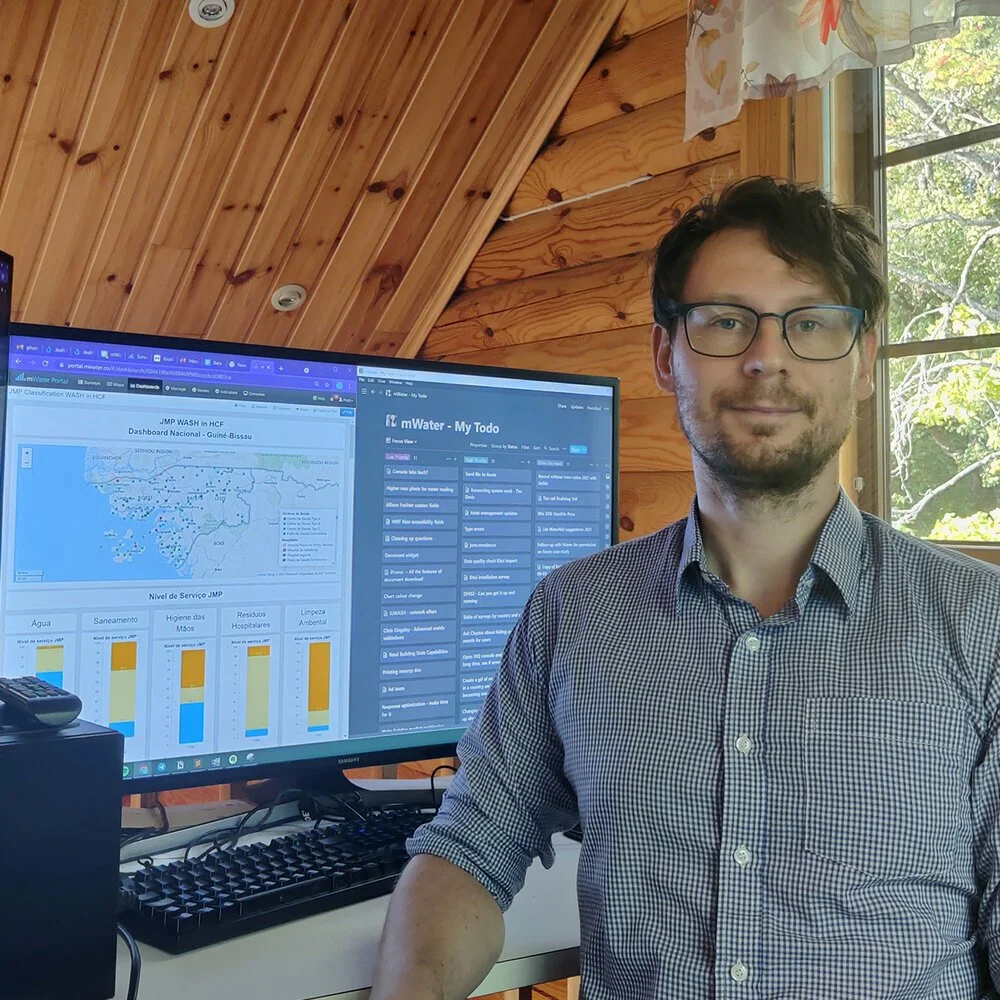
My work concerns how institutions put data to use: how it informs decisions, directs resources, and becomes part of the daily work of delivering public services.
Since 2018, I have led product development at mWater, working with governments, utilities, and development partners around the world to put data into operational use.
I have helped shape strategy, launched Solstice, and written about data, AI, and institutional capacity. I am also Venture Lead at Stellar Data. Across these roles, I combine product leadership with consulting, training, and software development.
I am interested in how AI can extend this capacity, and what it takes for institutions to understand, govern, and sustain the systems they rely on.
From launching Solstice to shaping shared tools: examples of my leadership, working with our team and partners.
01 / Product and venture leadership
Solstice: from an idea to adoption across sectors
When I joined mWater in 2018, Solstice was an idea for extending the platform beyond water and sanitation. I led its development into a product: shaping the brand and positioning, implementing the app deployment and parallel portal, and managing projects, staff, and partner relationships.
At Medair, I encouraged the WASH team to adopt the Solstice identity so the system could find a home in other parts of the organisation. Its use subsequently expanded into health and other areas. This was the wider purpose: make shared infrastructure useful across institutional responsibilities.
By September 2026, Solstice had grown to more than 42,000 registered users across 155 countries. At that point, Solstice accounted for approximately one in five registrations across mWater and Solstice during 2026.
Internal platform registration data, September 2026. Registered accounts, not active users.
Users were bringing AI assistants to a platform built for people, and they needed capable access without losing control of their data.
My role
Product leadership and the platform’s published AI strategy.
Design choice
Give agents a supported, permission-aware route in, with people reviewing proposed data changes. Subsidised use with daily caps to democratise access to AI-boosted work.
In practice
Free in-built features help users do more in key areas such as data analysis. The MCP server connects assistants to users’ data. The Integrator helps practitioners connect external systems in plain language.
Much of this work takes shape with public institutions, including national systems in Zimbabwe, Uganda, Madagascar, and Papua New Guinea. My work also includes CRS Azure, which spans multiple countries.
mWater’s larger contribution is shared data infrastructure for water and sanitation. Governments, utilities, and development partners can build on the same tools rather than commission separate systems for each project. Improvements funded for one organisation become available to everyone, reducing duplicated development and helping teams spend more of their effort on delivering services.
What changes in practice
The practical value is in what people can do with the data: keep records current, follow up on service problems, and understand whether an intervention is helping. Published accounts from mWater and its partners give a few examples.
Uganda · RUMIS. Built and put into use in under a year, RUMIS made field collection and database updating a single task, with local, district, and national staff seeing the same information. The 2023 case study also describes training local technology professionals to support the system beyond mWater’s direct involvement. Read the RUMIS case study →
DR Congo · Yme Jibu. The utility brings customer records, meter readings, billing, and daily production monitoring together in mWater. In its 2025 account, the database manager reports easier data centralisation, automated monitoring, and invoices generated directly in the platform. Read the utility’s account →
Project Maji · Maintenance and learning. Project Maji adapted a maintenance dashboard shared by the Ugandan Water Project to track faults and assign technicians. It also uses digital surveys before and after kiosk installations to understand changes in communities’ lives. Read how Project Maji uses the data →
Small research projects that put AI-generated arguments and algorithms through proofs, counterexample searches and reproducible checks.
Experiment 01 · Preliminary result
Faster exact network checks
A candidate shortcut for measuring the geometry of densely connected networks, with an interactive link-loss experiment, an exact reference comparison and the research record. Novelty and independent mathematical review remain open.
Technology, institutions, and the people using both.
Before mWater, I worked on global information systems at WaterAid and mapping tools at the British Red Cross. That experience still shapes how I think about product development: the software has to fit the responsibilities, resources, and working lives around it.
I have done extensive consulting and training through UpBeam Oy, including engagements with WaterAid, the Netherlands Red Cross, and Water For People. Away from the product roadmap, I explore philosophy, writing, and small interactive projects.
Get in touch about product and AI strategy, putting institutional data systems into practice, training, or speaking. Tell me about your organisation, the problem you are working on, and the kind of contribution you have in mind.